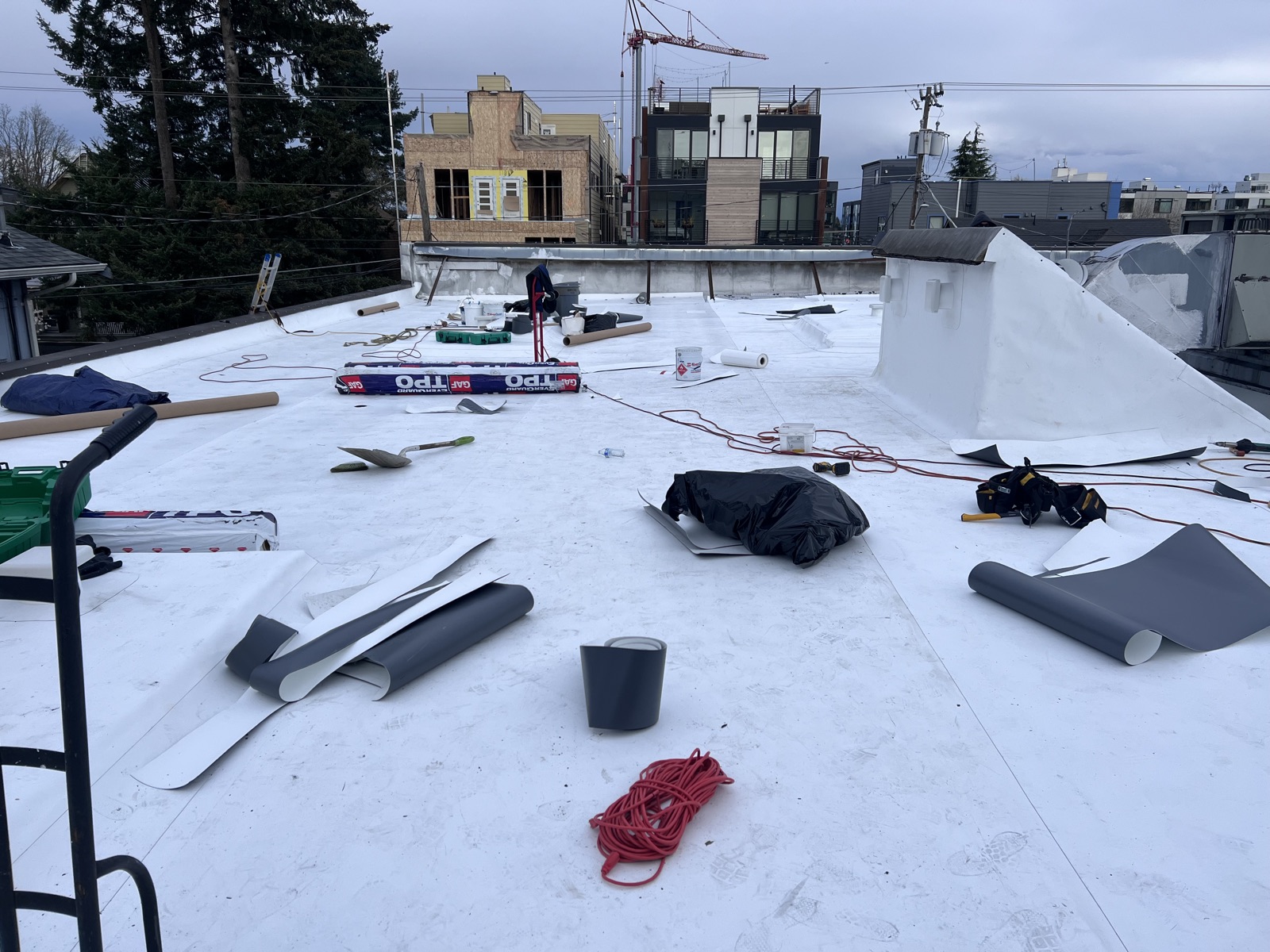
Quick answer: TPO and PVC are single sheets with heat-welded seams, and torch down is modified asphalt installed in layers. All three can keep a Seattle flat roof dry, so the right pick depends on what is on your roof, how the roof drains, and your budget.
What is the difference between TPO, PVC, and torch down?
TPO and PVC are single-ply membranes. Torch down is a layered asphalt system. The U.S. Department of Energy describes single-ply membranes as pre-fabricated sheets that are rolled onto the roof and attached with mechanical fasteners, adhered with adhesives, or held in place with ballast.
Torch down is the common name for modified bitumen. According to the Asphalt Roofing Manufacturers Association (ARMA), it is asphalt modified with a polymer, either SBS or APP, and reinforced with one or more plies of fabric. We install the SBS type.
| TPO | PVC | Torch down (SBS) | |
|---|---|---|---|
| What it is | Single-ply plastic membrane | Single-ply plastic membrane | Polymer-modified asphalt sheets |
| Layers | One sheet | One sheet | Usually two to four plies (ARMA) |
| Seams | Welded with heat | Welded with heat | Sheets bonded with a torch |
| Usual surface | Typically white (U.S. Department of Energy) | Typically white (U.S. Department of Energy) | Mineral granules or a smooth finish |
| Known for | Sold as the cost-effective option | Made to resist oils, fuels, and harsh chemicals | More than one layer of protection |
| BSR installed price | $600 to $1,000 per square | $600 to $1,000 per square | Quoted by the job |
One square is 100 square feet of roof.
Which flat roof is best for Seattle rain?
Any of the three, as long as the roof drains. On a flat roof, how fast the water leaves matters more than which membrane is under it.
ARMA recommends a slope of at least 1/4 inch per foot, and notes that model building codes require the same minimum on new construction. If water sits on your roof for days after a storm, fix the drainage as part of the new roof. Changing the material alone will not solve it. Our guide on ponding water on a flat roof explains what to look for.
Is TPO or PVC better?
They are close. Both are heat-weldable membranes, and we price them in the same range. The difference is what each one is built to handle.
Johns Manville, a manufacturer of both, describes its TPO as a more cost-effective solution and describes its PVC membranes as resistant to harsh chemicals, oils, and fuels. So PVC earns its place on roofs with that kind of exposure, and TPO fits most other buildings.
Is torch down still a good flat roof?
Yes. Torch down is a proven system, and its strength is that it goes on in layers. ARMA says a finished modified bitumen roof is usually a two- to four-ply system.
ARMA also says SBS gives the asphalt rubber-like characteristics and improved resistance to aging and weathering. The top sheet usually comes with mineral granules. The U.S. Department of Energy notes that SBS roofs need that surfacing or a coating to protect them from the sun.
Do I need a white reflective flat roof in Seattle?
Not for energy savings alone. ENERGY STAR says cool roofs save the most energy in hot, sunny climates like the Southern U.S.
The U.S. Department of Energy adds that a cool roof reduces heat gain all year, which saves on cooling but can also increase the energy needed for heating. TPO and PVC are usually white anyway, so you get a reflective surface with either one.
How much does a flat roof cost in Seattle?
With us, a TPO or PVC flat roof runs $600 to $1,000 per square installed. A 30 square roof, which is 3,000 square feet, would land between $18,000 and $30,000 in that range.
Torch down depends on the number of plies and the details of the roof, so we quote it by the job. If the flat section is part of a house with a shingle roof, our free roof cost calculator gives you a baseline for the shingle part.
How long does a flat roof last in Seattle?
A TPO or PVC roof lasts about 20 to 30 years here.
ARMA warns that water left sitting on a roof may lead to accelerated erosion and deterioration of the membrane surface. Keep drains and scuppers clear.
Do I need a permit to replace a flat roof in Seattle?
On a commercial or multifamily building, yes. The Seattle Department of Construction and Inspections requires a re-roof permit for those buildings. Rules for houses are different, and we cover them in do I need a permit to replace my roof in Seattle.
Which flat roof should I choose?
Start with what is on the roof. If the roof sees oils, fuels, or chemicals, look at PVC. If you want a single-ply roof at a competitive price, look at TPO. If you want a layered system, or you have a small low-slope section on a house, look at torch down.
We install and repair all three on commercial and multi-family buildings and on low-slope sections of homes. See our commercial roofing page, then request your free estimate or call (206) 656-4999.
BSR Constructions LLC is a family-owned, licensed and insured Seattle roofing contractor rated 4.9 stars on Google. We install TPO, PVC, and torch down roofs, estimates are free, and our work comes with a 10-year workmanship warranty. Call (206) 656-4999.