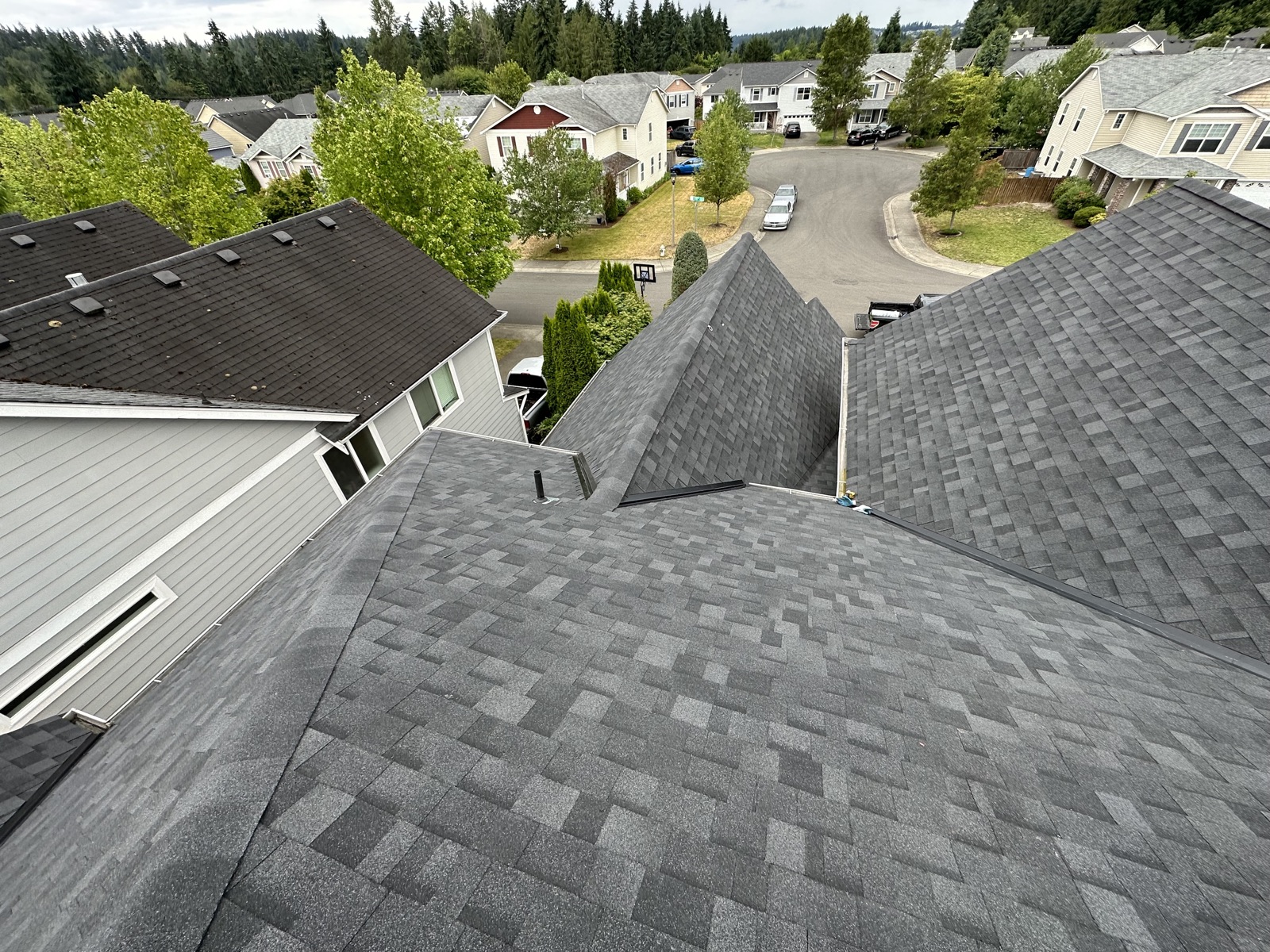
Quick answer: Attic ventilation moves air under your roof so heat and moisture do not build up there. Without it, shingles and roof decking can wear out early, and inadequate ventilation can void a manufacturer shingle warranty.
What does attic ventilation do for a roof?
It keeps air moving through the attic. The Asphalt Roofing Manufacturers Association (ARMA) describes ventilation as a system of intake and exhaust that creates a flow of air, and says the result is a cooler attic in summer and a drier attic in winter.
Both halves have a place on the roof. ARMA says intake vents belong at the lowest point in the attic, typically in the soffit or near the roof's edge, and exhaust vents belong at or near the ridge.
What happens when an attic is poorly ventilated?
Heat and moisture get trapped under the roof deck, and both do damage. ARMA lays out what that looks like:
- Heat. In a building with poor ventilation, attic temperature may reach 140 degrees on a 90 degree day. ARMA says that can damage roof decking and shingles, which can become distorted and deteriorate prematurely.
- Condensation. In winter, warm, moist air from the house rises into the attic and condenses on cold surfaces. ARMA says this can make the deck swell, causing waviness and buckling in both the deck and the shingles.
- Rot. ARMA warns the water can rot the roof deck, destroying its ability to carry loads and hold nails.
- Mold. Damp insulation leads to wood rot, mold, and mildew.
Seattle does not see many 90 degree days. It sees plenty of cool, damp ones, and those are the conditions where the condensation problem shows up.
What are the signs of poor attic ventilation?
Most of the signs are moisture where it should not be. Based on ARMA's guidance, watch for:
- A roof surface that looks wavy or buckled
- Water stains on the underside of the roof deck that do not line up with any leak
- Rusted nail tips or dark, soft wood in the attic. ARMA notes that excess moisture can cause nails to corrode and wood to rot.
- Damp or matted insulation, or mold and mildew
- Soffit vents blocked by insulation or debris. ARMA says intake vents should not be blocked by either.
- Higher energy bills
You can spot some of these from the attic hatch with a flashlight. Do not climb on the roof to look, especially when it is wet, steep, or damaged.
How much ventilation does an attic need?
Enough to meet your local building code and your shingle manufacturer's requirements, and it has to be balanced. ARMA says that in general the net-free area of intake venting should be equal to or greater than the net-free area of exhaust venting. Net-free area is the unobstructed opening air can actually pass through.
Balance is the part that gets missed. ARMA explains that balance means half of the vent area sits high in the attic for exhaust and half sits low for intake. Without that balance, the working ventilation is limited to the smaller of the two. A new ridge vent does little if the soffit vents are painted shut or buried in insulation.
Can poor attic ventilation void my roof warranty?
It can. Inadequate attic ventilation is a common reason manufacturer shingle warranties are voided. ARMA notes that shingle manufacturers have adopted industry ventilation standards as their minimum acceptable ventilation conditions.
What to do about it:
- Read the ventilation section of your own warranty. Terms vary, so check yours.
- Ask your roofer to show you how the intake and exhaust were figured for your attic.
Our roof warranty guide explains what a strong warranty covers. As a GAF Certified Plus contractor, we can register qualifying full GAF roofing systems for the Silver Pledge warranty.
Can attic moisture look like a roof leak?
Yes. ARMA notes that water stains in an attic may be due to condensation from inadequate attic ventilation.
That is why the cause has to be found before anything gets fixed. Patching shingles will not stop condensation. If you have water coming in and are not sure why, start with what to do when your roof is leaking, or see our roof repair page.
Should ventilation be fixed when the roof is replaced?
Yes, that is the best time to do it. ARMA says the reroofing process should include an evaluation to determine that the existing attic ventilation is adequate.
We check the ventilation and the decking on every roof before we write the estimate. If moisture has already rotted part of the deck, replacing it usually costs $80 to $100 per sheet. Most Seattle asphalt shingle replacements run $9,000 to $20,000, and you can get a quick number for your house with our free roof cost calculator.
Not sure the roof is ready for replacement yet? Our guide on roof repair or replacement can help you sort that out.
How do I find out if my attic is ventilated properly?
Have it checked from the attic and from the roof by someone trained to be up there. We look at the intake, the exhaust, the insulation around the vents, and the condition of the deck, and we show you photos of what we found. Request your free estimate here or call (206) 656-4999.
BSR Constructions LLC is a family-owned, licensed and insured Seattle roofing contractor rated 4.9 stars on Google, and a GAF Certified Plus contractor. Every roof we install is backed by our 10-year workmanship warranty. Call (206) 656-4999 for a free roof inspection.